
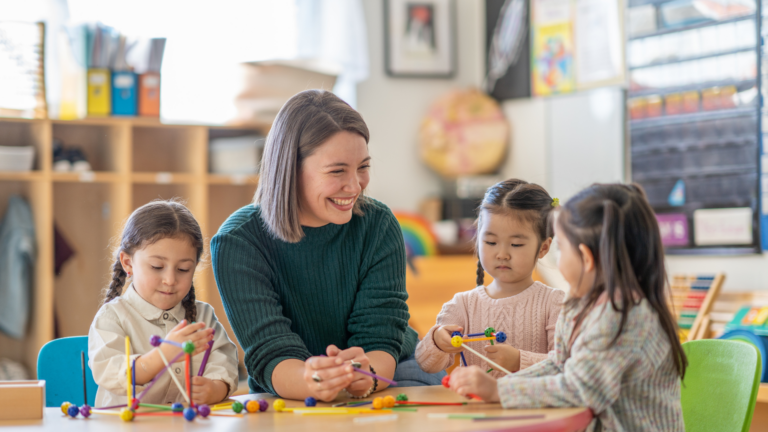

Play expands intelligence, stimulates the imagination, encourages creative problem solving, and helps develop confidence, self-esteem, and a positive attitude toward learning. (Dr. Fraser Mustard)
Play is a fundamental right of every child and a cornerstone of healthy development. It nurtures emotional, cognitive, and physical growth while strengthening children’s sense of identity as they explore their interests, express their thinking, and share ideas with others. In Kindergarten, children need ample time for play within a thoughtfully designed flow of the day that values play.
In the 2026 Ontario Kindergarten curriculum, educators are called to balance explicit instruction of foundational literacy skills with rich play experiences. The curriculum affirms play as an essential context for learning. Play is not a break from literacy learning — it is where foundational skills develop in authentic and meaningful ways. Through play, children explore, experiment, and communicate using oral language, storytelling, reading, and writing.
When foundational skills such as phonemic awareness, phonics, alphabetic knowledge and vocabulary are taught through evidence-based systematic and explicit instruction, they are strengthened when applied within meaningful play contexts. Children practise literacy skills while writing signs, creating menus, or labeling discoveries during play. This intentional connection helps children understand the purpose and power of literacy. In these moments, play becomes the bridge between instruction and meaningful application.
Play Continuum
How can we intentionally create opportunities to foster literacy through play? The Kindergarten curriculum identifies three types of play along a continuum: student-directed play, guided play, and educator-directed play. The level of child agency and educator involvement varies depending on the learning goals. Each type of play is important and can support the literacy expectations in the Kindergarten curriculum.
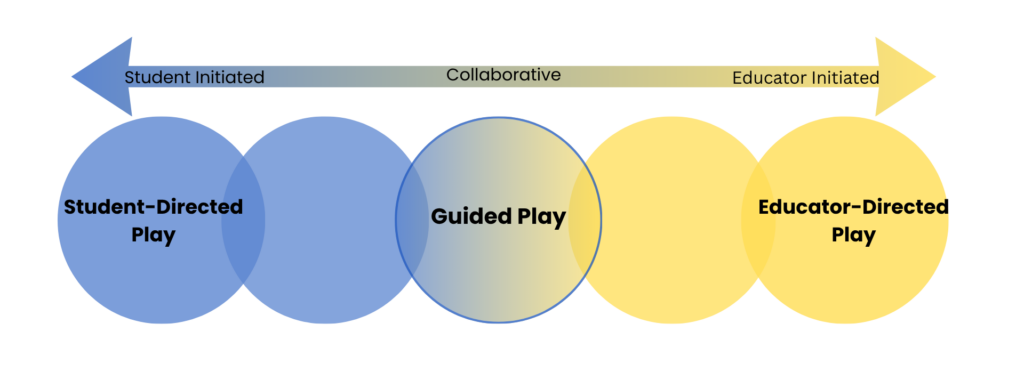
Student-directed play sits at one end of the continuum. Children lead the play, while educators observe, listen, and document learning. During this time, children may use and apply their literacy learning, in meaningful play contexts. By carefully observing children’s play, educators better understand their interests and preferences and can thoughtfully co-construct the learning environment so children can express their thinking and learning in many ways. This type of play strongly supports oral language development, social skills, and social-emotional learning.
On the other end of the continuum is educator-directed play, which is used when there are specific learning goals. Guided by information from universal screeners and ongoing progress monitoring, educators identify children’s learning needs and design playful, purposeful experiences to support targeted literacy skill development. In this approach, educators take a more active role by modelling, scaffolding, and providing feedback, while keeping learning hands-on, engaging, and interactive. Even with clear instructional intent, the focus remains on keeping learning playful and ensuring children are actively involved as they build foundational literacy skills.
Guided play sits in the middle of the continuum, where children lead the play and educators intentionally embed opportunities to practise and extend literacy skills. This approach balances high child autonomy with strong educator engagement. Explicit instruction can occur within guided play when it supports learning goals and children’s thinking. A key feature is the educator’s active presence, beginning with the thoughtful design of rich learning invitations throughout the classroom that offer multiple entry points so all children can participate and contribute. Educators then join children in play in ways that extend thinking, ask open-ended questions, introduce new vocabulary, document learning, and provide gentle prompts that support the next steps in literacy development. Guided play is not a one-size-fits-all approach; instead, educators adjust support based on children’s strengths, needs, and responses, creating learning contexts that are responsive and child-centred.
As we reflect on the play continuum, it is helpful to consider three guiding questions:
- Are we providing children with rich opportunities for student-directed exploration?
- Are we intentionally designing guided play that extends literacy thinking?
- Are we using educator-directed play strategically to support specific skill development?
Thoughtful consideration of these questions helps ensure that play is balanced across the continuum to support meaningful literacy learning.
Wrap-Up
Play remains a vital part of the Kindergarten day and is woven throughout both the indoor and outdoor learning environments. When people speak about play, they often add the word “just” — “Oh, they’re just playing.” As early years advocates, let us gently interrupt and change that narrative. There is nothing “just” about play, and guiding it well requires a deep understanding of how children play and how early literacy skills develop.
Play is a powerful vehicle for learning. When play and explicit instruction are intentionally connected, they enrich and reinforce one another, helping children build strong, joyful foundations in literacy. This is not “just” play — it is purposeful, joyful learning in action.
Play has been deeply misunderstood, and even more so, undervalued. Play is not an ‘extra’ and it is so much more than toys. Play has given us a natural way to heal from trauma, to recover emotional health, to build community, and to take in and digest the world around us. In addition to all of this, play can provide the space for discovering the gorgeous possibilities we hold within us. (Hannah Beach)
Resources
- Kindergarten – Flow of the Day: Structured Literacy and Play
- Kindergarten Drop-In Sessions – Recordings (especially the Flow of the Day episode)
- Play Learning Lab run by Dr. Angela Pyle
- Pyle, A., Wickstrom, H., Gross, O., & Kraszewski, E. (2024). Supporting children’s literacy development through teacher-facilitated play. Journal of Early Childhood Research.
- Supporting Literacy Development in Kindergarten Through Teacher-Facilitated Play (infographic of study results)
