


Phonemic Awareness is essential for learning to read and is a teachable skill that helps students get off to a good start with reading and writing. It is the ability to notice and work with sounds in words. Kindergarten students need to focus on 3 areas of phonemic awareness:
- Isolating phonemes (identifying a single sound in a word)
- Blending phonemes (combining sounds together to create spoken words)
- Segmenting phonemes (breaking apart words into each sound)
Why the focus on individual sounds, and not larger units like syllables? We know from research that teaching students to work with phonemes is the best way to support their reading and spelling, so this should be our instructional focus:
“Blending and segmenting at the phoneme level are the most important skills as they lead directly to decoding (sounding out simple words) and encoding (spelling simple words).” – Stephanie Al Otaiba et al., IDA Perspectives
As we were first learning about phonemic awareness in a structured literacy classroom, many adopted a separate program to teach phonemic awareness. As we have learned through research, phonemic awareness does not have to be any longer than a couple minutes of daily instruction and can be integrated into your phonics program that you are already using in your classroom. Here are a few ways to help incorporate phonemic awareness in your classroom – and you might be surprised that you’re already doing many of them already!
Focus on the Mouth (Articulatory Gestures): Explicitly teach your young learners how our mouths, tongues, and lips move to make specific letter sounds.
- Use Mirrors: Have students look at their mouths in small handheld mirrors. Ask: “Does your mouth match the sound picture? Does it match my mouth?”
- Voice On vs. Voice Off: Teach them to feel their throats to see if their “motor is running” (voiced sounds like /z/ or /m/) or off (unvoiced sounds like /s/ or /p/).
- Continuous vs. Stop Sounds: Explain if a sound stretches out forever (/m/, /s/) or stops quickly (/t/, /k/).
(For more information on articulatory gestures, check out Reading Universe: Skill Explainer.)
Scaffold the Learning: As you teach letter sounds to students, teach students to listen for a single sound in a word. Start with beginning sounds. These embedded picture mnemonics have instructional routine scripts on the back of the cards. These allow educators to teach the letter sounds AND connect it with the beginning sound of the key picture.
Use the “I Do, We Do, You Do” model. (Some students will need more modeling and will need to stay in the “I Do, We Do” model for longer than others. It does not need to be a linear model.)
- I Do: “Here’s a mitten. /m/ is the first sound in mitten.”
- We Do: “Let’s say it together: /m/ /m/ mitten.”
- You Do: “What is the first sound you hear in mitten?”
Put it into Practice: Use picture cards and have students sort them by their beginning sounds. For example, have students put all the /b/ pictures together on one side of the table and the /s/ pictures together on the other side. (This video from IES shows how you can sort picture cards.) As students gain success with beginning sounds, move to ending sounds, and finally middle (vowel) sounds as the year progresses.
Make the Invisible, Visible (Use Manipulatives): Help make sounds concrete by using manipulatives. We can help anchor the sounds students hear by using manipulatives.
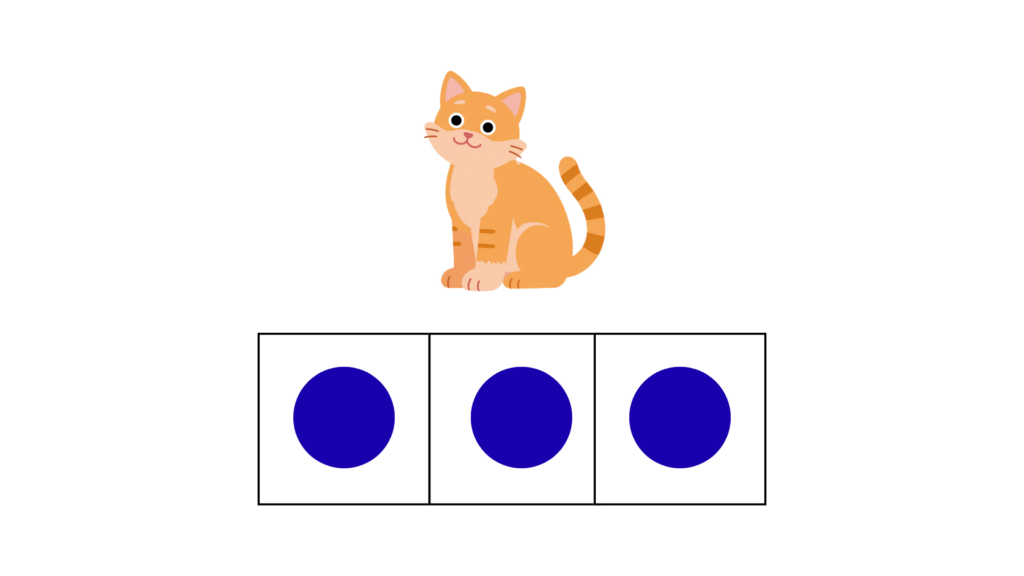
Elkonin (Sound) Boxes: Draw 2 or 3 boxes on a whiteboard/paper or have sound boxes strips available. Have students push a token, button, or block up into a box (or car into a “parking space”) for each sound they hear. Use picture cards at first to ensure understanding of the words, but remove the pictures and provide verbal words as skills are developed. (See Say it, Move it for practice mat and other videos on this topic; Using Elkonin Boxes also has examples.)
Body Tapping: Have students tap out sounds on their fingers, down their arms, or by jumping to give a concrete anchor to the sound.
Two to Three Phonemes: Stick to words with 2 or 3 phonemes. Using continuous sounds first (e.g., /m/, /f/, /s/) then moving into stop sounds (/p/, /t/, /d/).
- 2 sounds: us (/u/ /s/)
- 3 sounds: sun (/s/ /u/ /n/)
- 3 sounds: bath (/b/ /a/ /th/)
Check out this Phoneme Awareness Word List for lists of words you can use.
Don’t Linger in the Dark – Connect to Letters: While phonemic awareness is an oral/auditory skill, we do not want to linger in “oral-only” activities for too long. Our ultimate goal is for students to read and write words.
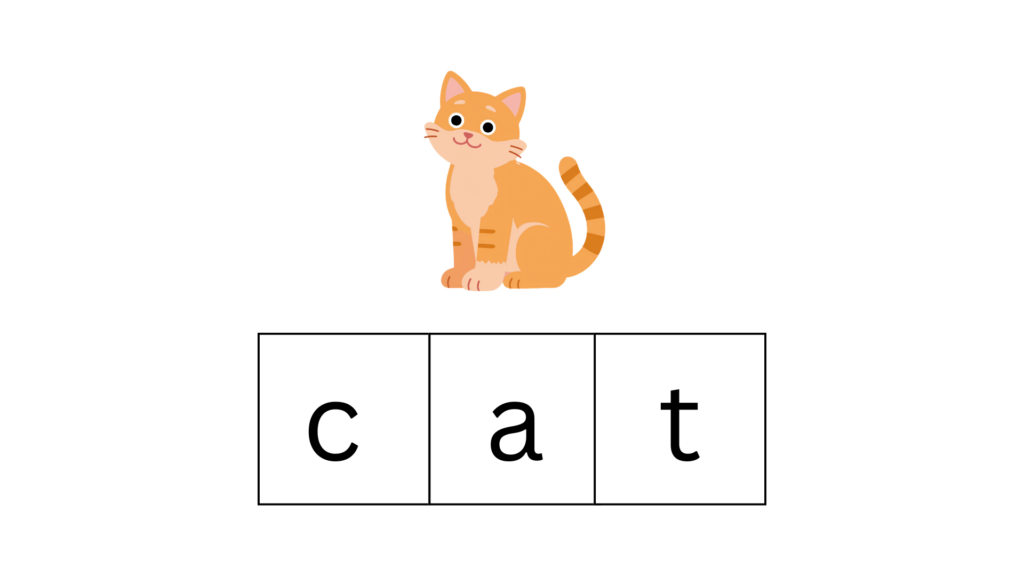
As soon as a child can orally isolate a sound, introduce the most common letter (grapheme) that represents it. Transition from using blank tokens in your Elkonin boxes to using magnetic letters or dry-erase markers so students map the phoneme directly to the grapheme.
Try Word Chaining: Using movable letters to create word chains is a brilliant way to integrate phonemic awareness with phonics. With word chains, you can alternate between having students read words (decoding) and write words (encoding).
- Build: Create the word mat. Have students blend sounds together to read it.
- Change the Beginning: “Change the first sound /m/ to /p/. Let’s blend the sounds together. What is our new word?” (pat)
- Change the Middle: “Change the middle sound /a/ to /i/. What word do we have now?” (pit)
- Change the End: “I am changing pit to pin. What sound did you hear change?” (The ending sound changed from /t/ to /n/)
Phonemic awareness is a crucial stepping stone to understanding the alphabetic system and key predictor of reading success. Focusing on isolating, blending and segmenting sounds will support students to become successful at decoding (reading) and encoding (writing), which is the ultimate goal for all learners.
Resources
- Blending/Segmenting Games
- ONlit Phonemic Awareness Overview
- ONlit Grade 1 Guide
- IDA Fact Sheet: Building Phoneme Awareness: Know What Matters
- Look out for the Kindergarten Phonemic Awareness page coming at the end of April in the new ONlit Kindergarten section!
