
Grade 9 – Unit 2
Informational Text: Ink and Identity
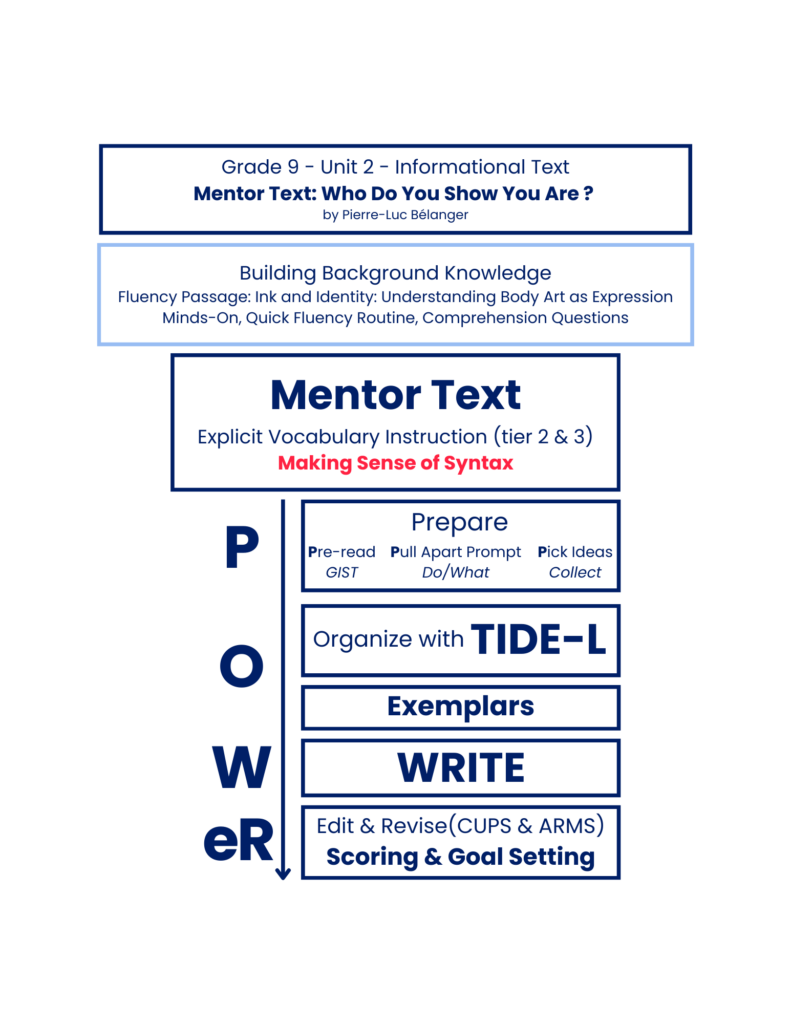
In Unit 2, students examine how writers explore identity through reflection, examples and cultural context. Using the mentor text Who Do You Show You Are?, students analyze how the author connects personal experiences with broader social and cultural ideas about expression and belonging.
Throughout the structured writing cycle, students learn how to analyze an informational mentor text, gather and organize ideas, and plan their writing using the Releasing Writers TIDE structure. Students develop their ability to present a clear perspective supported by examples and explanations. Through the mentor text, exemplars, vocabulary development, and guided practice, students strengthen their ability to communicate ideas about identity and expression in thoughtful, organized writing.
Fluency in Perspective
Fluency Text – Ink and Identity
In Unit 2, the fluency passage invites students to consider body art as a form of communication and identity. The text Ink and Identity: Understanding Body Art as Expression explores how tattoos, piercings, and other forms of body modification have carried meaning across cultures, generations and historical periods.
As students engage in repeated readings, they strengthen accuracy, pacing, and expression while also developing familiarity with the academic language and ideas connected to identity, culture, symbolism, and perspective. This routine supports both reading fluency and deeper comprehension of the themes that will guide the unit.
- Fluency Passage – Ink and Identity: Understanding Body Art as Expression
- Educator Resource -Fluency
- Educator Quick Reference Sheet – Fluency
- Instructional Slide Deck – Fluency
- Quick Fluency Routine
Structured Writing Cycle
Informational Text – Ink and Identity
In Unit 2, students examine how writers explore identity through reflection, examples, and cultural context. Using the mentor text Who Do You Show You Are?, students analyze how the author connects personal experiences with broader social and cultural ideas about expression and belonging.
- Mentor Text – Who Do You Show You Are? by Pierre-Luc Bélanger
- Educator Resource – Structured Writing
- Educator Quick Reference Sheet – Structured Writing
- Instructional Slide Deck – Structured Writing
- Instructional Slide Deck – Vocabulary
- Printable Cards – Vocabulary
- Colour Coded Exemplars
- Student Exemplars
Making Sense of Syntax
In Unit 2, students deepen their understanding of sentence structure by exploring how writers connect ideas clearly and effectively. Using examples connected to the themes of identity and expression in the mentor text Who Do You Show You Are?, students learn how coordinating conjunctions help link ideas and strengthen the flow of informational writing.
Across the four lessons, students explore the use of coordinating conjunctions (FANBOYS) to join equal elements in a sentence and to combine independent clauses to form compound sentences. They also learn to identify and repair common sentence errors such as run-on sentences and comma splices, while considering how authors make intentional choices about sentence structure to shape meaning and style.
Lessons in this unit include introducing coordinating conjunctions, combining sentences using FANBOYS, identifying and repairing run-on sentences and comma splices, and applying these structures to revise and write clear compound sentences.
- Lessons and Educator Overview – Syntax
- Instructional Slide Deck – Syntax
- Printable resource – Lesson 2
- Printable Resource – Lesson 4
- Basic English Sentence Structure Diagram