
Grade 9 – Unit 3
Persuasive Text: Truth on Trial
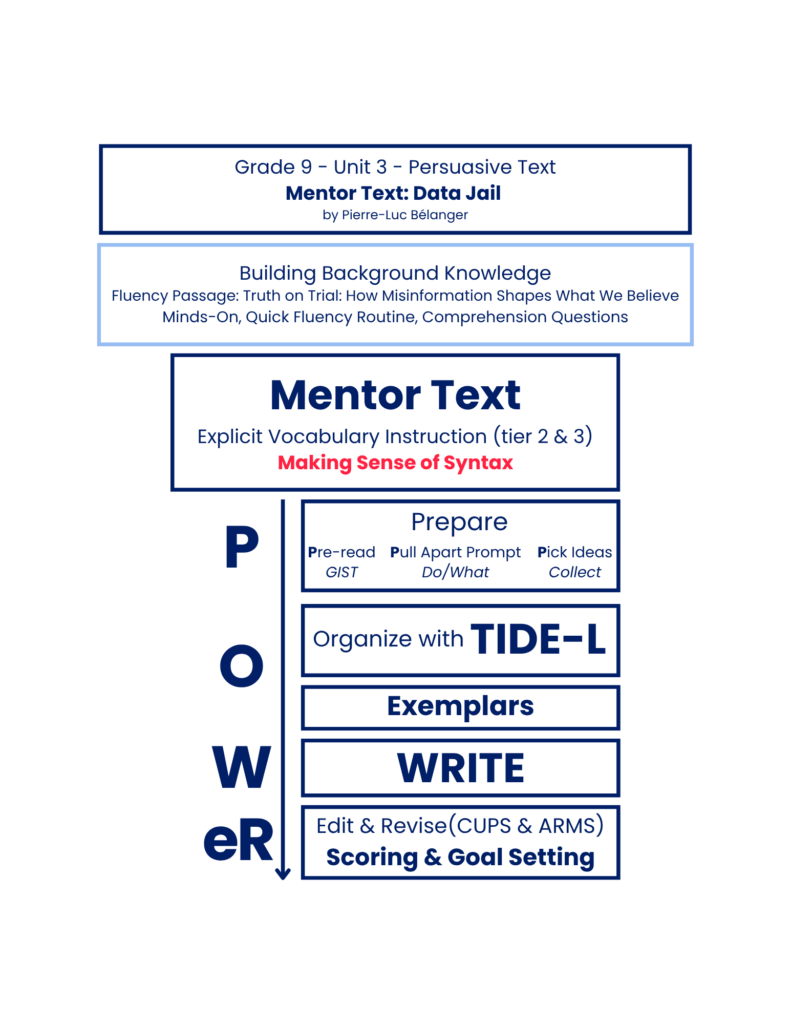
Unit 3 shifts the focus to persuasion, examining how ideas are shaped, framed and communicated to influence an audience. Through a blend of informational and satirical texts, this unit invites students to question how messages are constructed and how language can position readers to think in particular ways.
Anchored in the mentor text Data Jail, the unit explores how humour, exaggeration, and selective detail can be used not only to entertain, but to critique and persuade. Students consider whose perspectives are amplified, how arguments are structured, and what makes a message convincing in different contexts.
Fluency in Perspective – The Truth on Trial: Misinformation and Influence
The fluency work in this unit is grounded in contemporary issues of misinformation and digital media. The passage situates students in a world where information moves quickly, and not always accurately, highlighting the real-world consequences of unchecked claims. Across the week, repeated reading supports not only increased fluency, but also deeper engagement with complex ideas related to credibility, bias, and the role of media in shaping public understanding. The language and structures of the passage also serve as a model for the types of arguments and explanations students will encounter and construct throughout the unit.
- Fluency Passage – The Truth on Trial: Misinformation and Influence
- Educator Resource -Fluency
- Educator Quick Reference Sheet – Fluency
- Instructional Slide Deck – Fluency
- Quick Fluency Routine
Structured Writing Cycle – Persuasive Text: Truth on Trial
The structured writing cycle in Unit 3 centres on persuasion through a satirical lens. In Data Jail, the author presents an exaggerated solution to a familiar social issue, prompting readers to look beyond the surface and consider the underlying message. This unit guides students in unpacking how arguments are built, how tone, word choice, and example selection contribute to a writer’s position. From there, students develop their own persuasive pieces, organizing their thinking through a clear structure and refining how they communicate their stance to a specific audience. Attention is placed on crafting arguments that are coherent, purposeful, and supported, while also recognizing that persuasion can take many forms, from direct argumentation to satire and critique.
- Mentor Text – Data Jail by Pierre-Luc Bélanger
- Educator Resource – Structured Writing
- Educator Quick Reference Sheet – Structured Writing
- Instructional Slide Deck – Structured Writing
- Instructional Slide Deck – Vocabulary
- Printable Cards – Vocabulary
- Colour Coded Exemplars
- Student Exemplars
Making Sense of Syntax
The syntax work in this unit deepens students’ control over sentence complexity, with a focus on how ideas are connected within and across sentences. Building on earlier learning, students explore how subordinating conjunctions allow writers to signal relationships such as cause, contrast, and condition.
Beyond sentence-level work, this unit introduces the concept of cohesive ties, the linguistic links that connect ideas across a paragraph. Using excerpts from Data Jail, students examine how meaning is carried forward through reference, context, and implied connections, and how these can either support or challenge comprehension. This dual focus on sentence construction and text cohesion strengthens both reading and writing, supporting students in producing more precise, fluid, and logically connected arguments.
- Lessons and Educator Overview – Syntax
- Instructional Slide Deck – Syntax
- Printable resource – Lessons 1 and 2
- Printable resource – Lesson 3
- Printable Resource – Lesson 4
- Basic English Sentence Structure Diagram